
Positioning Is Subtraction: Why Strong Brands Are Built on What They Say No To
Most positioning exercises end with a longer list than they started with. Everyone adds a priority, nobody removes anything, and the brand ends up standing for everything and, in the customer's mind, very little. Positioning is not addition. It is subtraction. A brand's position is defined less by what it claims than by what it is willing to give up, and until the choice involves a real trade-off, it is not yet a decision at all.
Last updated: October 16, 2026

Most positioning exercises end with a longer list than they started with. The brand wants to be trusted, innovative, affordable, premium, local and global. It wants to appeal to the cautious buyer and the ambitious one, to own quality and value, exclusivity and accessibility, all at once. Everyone in the room adds a priority, nobody removes anything, and the result is a brand that stands for everything and, in the customer’s mind, very little.
Positioning is not addition. It is subtraction. A brand’s position is defined less by what it claims than by what it is willing to give up. Strong brands earn a distinct place in people’s minds by making deliberate choices about whom they serve, what they promise, and what they refuse to compromise. Those choices come with real trade-offs, and until a positioning decision involves one, it is not yet a decision at all.
A position is what you are willing to give up
Ask a leadership team what its brand stands for, and you will get a list of virtues. Ask what the brand is willing to sacrifice to stand for them, and the room goes quiet. That silence is where the real work begins. A position is not a collection of desirable qualities. It is a deliberate choice: this over that, for these customers rather than everyone. Premium, even if that means sacrificing some price-sensitive buyers. Simplicity, even if it means leaving advanced features out. Specialisation, even if it means declining opportunities outside the brand’s core.
The trade-off does not always mean turning customers away. Sometimes it means prioritising one benefit over another, refusing to compete on every price point, or choosing not to dilute the experience that makes the brand valuable. The difficult part is accepting that a clear choice will not appeal equally to everyone. Brands that refuse to make it do not become more versatile. They become less meaningful.
Why addition feels safe and quietly weakens a brand
Addition always feels safe, because every new promise looks like another opportunity. Another audience to include. Another feature to introduce. Another product tier to fill. Each decision can be justified on its own, which is exactly why the process is so dangerous. The problem rarely begins with one obviously bad call. It develops through a series of reasonable ones that gradually pull the brand in different directions, and no one notices the moment it stopped meaning anything.
The consequences are subtle at first. The messaging becomes less distinctive. The customer struggles to name a compelling reason to choose. Marketing has to work harder to communicate the same value. Eventually price becomes the deciding factor, because the brand has failed to establish a meaningful difference. A brand that stands for something clearly gives people a reason to remember, recommend and choose it. A brand that stands for several things vaguely has to keep explaining why it matters. The cost of unclear positioning is not a lack of awareness. It is awareness without preference.
The sacrificial decision
The most useful question in positioning is not “what do we want to be known for.” It is “what are we prepared to prioritise, even when it means giving something else up.” A premium brand prioritises perceived value over being the cheapest. A specialist prioritises depth over the breadth of a generalist. A brand built on simplicity prioritises ease of use over an abundance of features. None of these choices is universally right. Their value depends on the market, the customer, and the brand’s ability to deliver on the promise. But each creates a basis for distinction.
When a brand cannot name what it is willing to sacrifice, its positioning is an aspiration, not a strategy. The trade-off is what makes the promise credible, because it proves the brand has chosen and is prepared to act on it. Customers do not need a brand to be everything. They need it to be right for a reason that matters to them.
A position no one could disagree with is not much of a position
Here is a simple test. State your positioning clearly, and ask whether a credible competitor could claim the same thing without changing anything about its business. If every competitor could, the claim will not create much distinction. “We put customers first.” “We deliver quality.” “We believe in innovation.” These may be real commitments, but no serious competitor advertises that it puts customers last or delivers poor quality on purpose. The problem is not that these values are unimportant. It is that they are too broad to explain why a customer should choose one brand over another.
A meaningful position makes a more specific choice: a particular customer need, a distinct value, an approach the brand can credibly own and that a competitor could reasonably choose differently. That is what makes it meaningful. If every brand in your category could adopt your positioning without changing its behaviour, you have identified a category expectation, not a competitive advantage.
Subtraction is hardest in crowded, trade-led markets
In the markets where I have spent much of my career, the pressure to add is relentless. Another dealer segment to serve, another price tier to cover, another product line so a competitor does not occupy the gap. In trade-led markets, broader distribution and a wider portfolio can create real commercial advantages, so the instinct is rewarded in the short run. The challenge is not that expansion is wrong. It is that commercial expansion can happen faster than strategic clarity. A brand can reach more outlets, offer more products and serve more customers without becoming the preferred choice for any particular reason. Availability creates opportunity. It does not automatically create preference.
This is where positioning earns its keep. A brand needs to know what stays consistent across its portfolio, which customers it intends to prioritise, and what distinctive value it wants its name to carry. Not every product has to serve the same need, and not every customer has to hear the same message, but the choices should reinforce one organising idea rather than add up to a collection of disconnected commercial decisions. In a market where every competitor keeps adding, disciplined focus becomes a powerful advantage, not because breadth has no value, but because breadth without a clear organising idea is almost impossible to turn into preference.
How to find what to cut
The practical starting point is to bring the trade-offs into the open. List the promises, attributes and associations the brand currently claims, then ask five questions of each one.
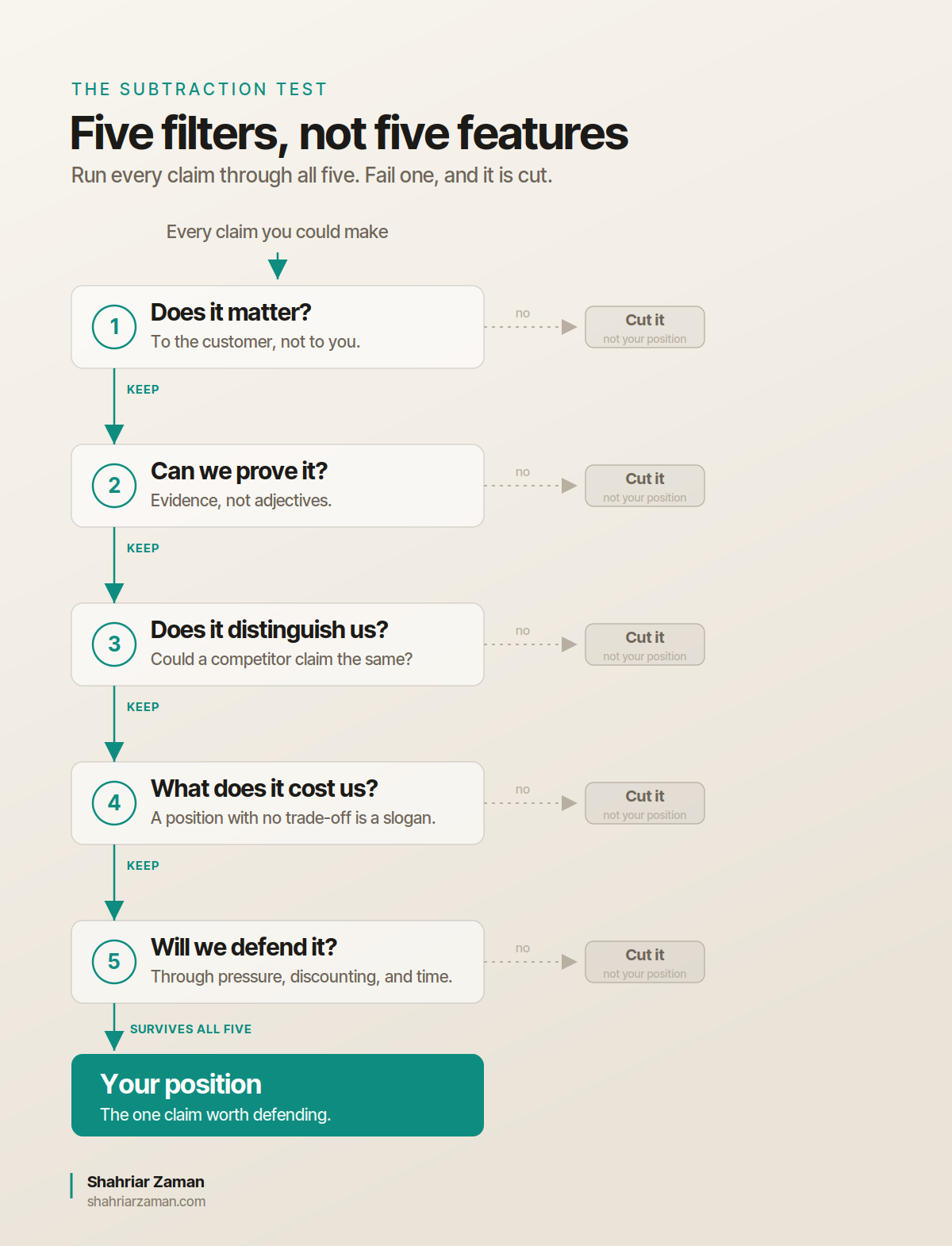
- Does it matter? Is this something the priority customer genuinely values?
- Can we prove it? Can the brand deliver on it consistently and credibly?
- Does it distinguish us? Does it give customers a real reason to choose us over the alternatives?
- What does it cost us? What must we prioritise, change or give up to own it?
- Will we defend it? Will we hold the choice when a short-term opportunity tempts us the other way?
Some claims will prove essential. Others will turn out to be basic expectations, unsupported aspirations, or distractions from the brand’s central value. The objective is not to remove as many claims as possible. It is to find the few strategic choices that deserve priority and align the business around them. Then comes the harder task: protecting them. The pressure to add never disappears. A strong position should evolve when the market or the evidence demands it, but it should not change every time a new opportunity appears. Focus is not stubbornness. It is the discipline to know which changes strengthen the brand and which merely make it busier.
The real question
The question is not “what can we add to make the brand more appealing.” It is: what are we willing to prioritise, and what are we prepared to give up to make that choice mean something? A brand does not need to serve the smallest possible market or reject every opportunity. It needs to make choices that give customers a clear, credible and relevant reason to prefer it, and then line up its products, pricing, experience, distribution and communication behind the same intent.
Positioning is subtraction because distinction requires choice. The strongest brands are not the ones that offer the most or serve the fewest. They are the ones that know what matters most, organise the business around it, and resist the temptation to become everything to everyone. They know what they stand for. More importantly, they know what they will not compromise to stand for it.
Key takeaways
- Positioning is subtraction, not addition. A brand becomes distinctive by choosing what to prioritise, not by claiming every desirable attribute.
- Addition always feels safe, but a series of reasonable additions produces a brand that means little and ends up competing on price.
- Every meaningful position has a cost: a benefit, a segment, or a short-term opportunity the brand gives up. If you cannot name the sacrifice, you have an aspiration, not a strategy.
- Distinctiveness beats generic virtue. If every competitor could make your claim without changing its behaviour, it is a category expectation, not a position.
- In trade-led markets, availability creates opportunity but not preference. Focus is rare precisely because adding is always rewarded in the short run.
- To find what to cut, keep only the claims that matter, that you can prove, that distinguish you, whose cost you accept, and that you will defend. Then protect them from the slow return of addition.