Two Markets, One Discipline: What Bangladesh and New Zealand Taught Me About Meaning
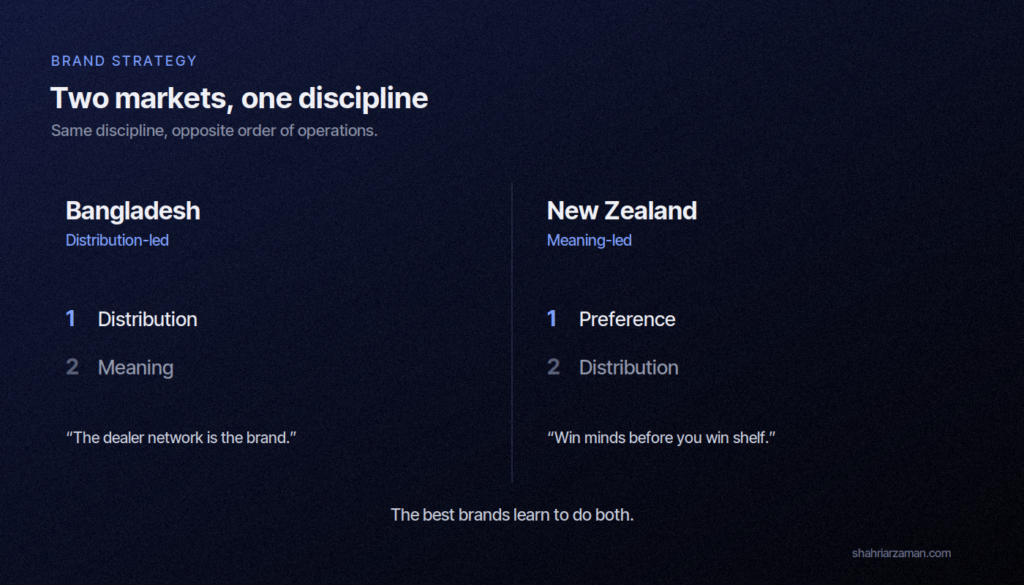
For most of my career I built brands in Bangladesh. I now build them from New Zealand, with one foot still in Dhaka. I expected a change of scenery. What I got was a change of perspective, because the two markets run the discipline of marketing in the opposite order. One builds availability and then earns meaning. The other builds meaning and then earns availability. Learning to see both orders at once changed how I think about brand-building more than any single campaign ever did.
Last updated: September 26, 2026
For most of my career, I built brands in Bangladesh. I now build them from New Zealand, with one foot still firmly in Dhaka. I expected the move to be a change of scenery. What it actually became was a change of perspective, because the two markets do not just differ in size or maturity. They run the discipline of marketing in the opposite order.
I had assumed, as most marketers quietly do, that the principles travel unchanged and only the tactics adapt. That is half right. The principles do travel. But the sequence in which a brand is built, what you invest in first and what you earn later, flips almost completely between a distribution-led market and a meaning-led one. Learning to see both orders at once has changed how I think about brand-building more than any single campaign ever did.
In Bangladesh, distribution is destiny
In Bangladesh, and across much of South Asia, a brand is built from the shelf outward. The dealer network is the brand. Reach the trade, earn the retailer’s trust, get your product within arm’s reach of the customer, and volume follows. Distribution is not a logistics function sitting downstream of marketing. It often is the marketing.
This is not a primitive version of brand-building waiting to be modernised. It is a rational response to the market’s reality. Where digital payment, courier reliability, and e-commerce trust are still maturing, the retailer’s shelf is the most credible endorsement a brand can get. A shopper trusts the familiar shop far more than an unfamiliar checkout page. In that world, meaning matters, but it is built on top of availability, not before it.
In New Zealand, meaning comes first
New Zealand inverts the order. Retail is consolidated, the shelf is effectively rented, and getting onto it is a commercial negotiation, not a growth strategy in itself. A brand cannot buy its way to preference through sheer presence, because presence is capped and expensive. So the work moves upstream. You have to win the consumer’s mind before you earn the right to the shelf, not after.
Here, a brand’s point of view, its values, the story it tells and keeps, does the heavy lifting that distribution does back home. Meaning is not a finishing layer applied once the product is everywhere. It is the entry ticket. That reordering was the most disorienting, and the most instructive, part of working across both.
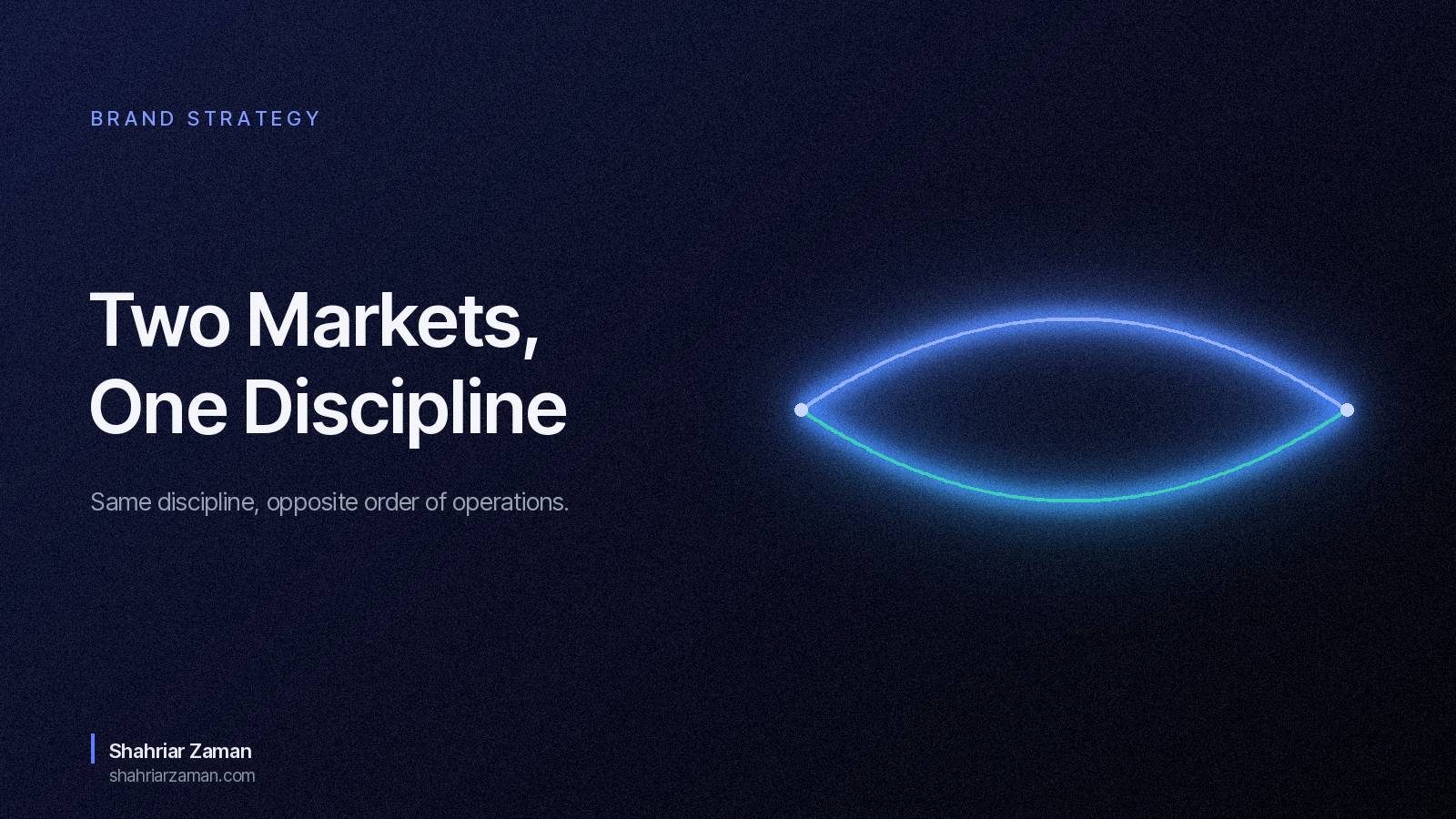
Same discipline, opposite order
It would be easy to conclude that one market is advanced and the other behind. That reading is both wrong and lazy. Both markets are answering the same strategic question: how do you get a customer to choose you and keep choosing you. They simply start from opposite ends. One builds availability and then earns meaning. The other builds meaning and then earns availability.
Once I saw it that way, the hierarchy dissolved. A distribution-led brand is not unsophisticated, it is solving the reach problem first because reach is the binding constraint. A meaning-led brand is not precious, it is solving the preference problem first because preference is the binding constraint. The discipline is identical. Only the sequence changes, dictated by which constraint the market imposes.
What each market is blind to
Each order has a blind spot, and naming them honestly matters more than defending either.
The distribution-led brand can mistake availability for loyalty. It grows so efficiently on reach that it never builds the preference that would protect it the day a competitor matches its shelf. It has volume, and assumes it has a brand. Often it has only the first.
The meaning-led brand has the opposite weakness. It can fall in love with its own story and underestimate the unglamorous grind of getting a product reliably into a customer’s hands. A beautiful brand that is hard to buy is not a brand yet. It is a mood.
The bridge
The value of working across both, I have come to believe, is not choosing a side. It is holding both orders in your head at once. The most durable brands I now watch do exactly that. They build distribution with the discipline of a South Asian trade marketer and preference with the intent of a mature-market brand builder, and they treat the two as one continuous system rather than competing philosophies.
For a brand operating in an emerging market, the opportunity in this is large and largely unclaimed. Most competitors are still optimising a single order. The brand that learns to run both, to earn meaning while it is still winning on reach, climbs faster and defends better than either specialist can.
The real question
So the question I now carry into every market, whichever end it starts from, is the same: are we building the thing that makes a customer choose us, or only the thing that makes us easy to reach? Reach without preference is fragile. Preference without reach is a rumour. A brand that lasts is built from both, and the only real variable is which one your market makes you earn first.
Two markets taught me that lesson from opposite directions. The discipline was the same all along. I simply had to stand in both places to see it whole.
Key takeaways
- Marketing principles travel between markets, but the order in which a brand is built inverts between distribution-led and meaning-led markets.
- In Bangladesh and much of South Asia, distribution comes first: the dealer network and the retailer’s shelf are the brand, and meaning is built on top of availability.
- In New Zealand, meaning comes first: shelf space is capped and rented, so a brand has to win the consumer’s mind before it earns distribution.
- Neither order is more advanced. Both answer the same question, choose us and keep choosing us, starting from whichever constraint the market imposes.
- Each order has a blind spot: distribution-led brands can mistake availability for loyalty; meaning-led brands can underestimate the grind of getting a product into customers’ hands.
- The advantage belongs to brands that hold both orders at once, earning meaning while still winning on reach, and treating distribution and preference as one system.

Written by
Shahriar Zaman
Brand strategist and fractional CMO with 15 years of building category brands. Founder of Ads of Bangladesh and co-founder of Brand Practitioners Bangladesh. Based in Auckland.