A Brand Is a Belief System: Why the Strongest Brands Are Built on Kept Promises, Not Campaigns
Ask most companies how their brand is doing and they show you reach and impressions, the attention they bought last quarter. It is the wrong scoreboard. A brand is not what you say about yourself in the moments you control. It is what people believe about you in the moments you do not, when your name comes up and you are not in the room. Once you accept that, brand-building stops being a communications exercise and becomes the deliberate construction of a belief, one kept promise at a time.
Last updated: September 26, 2026
Ask most companies how their brand is doing and they will show you reach, impressions, engagement, the volume of attention they bought last quarter. It is the wrong scoreboard. Attention tells you how many people you reached. It says almost nothing about what any of them now believe.
A brand is not what you say about yourself in the moments you control. It is what people believe about you in the moments you do not, when your name comes up and you are not in the room to defend it. Once you accept that, brand-building stops being a communications exercise and becomes something slower and harder: the deliberate construction of a belief, one piece of evidence at a time.
A brand is a belief, not a message
A message is something you broadcast. A belief is something someone holds. The two are related, but they are not the same, and confusing them is the most common and expensive mistake in marketing. You can control your message completely and still have almost no influence over the belief, because belief is assembled by the person, out of everything they have experienced of you, not just what you told them.
This is why a brand cannot be installed by a campaign, however brilliant. A campaign can introduce a belief, frame it, give it words. But the belief only takes hold if the rest of the experience agrees with the message. When the experience and the message disagree, people believe the experience. Every time.
Belief is built by evidence, not assertion
People do not believe brands because brands assert things. They believe brands because the evidence keeps confirming the claim. A brand that says it is premium and then behaves cheaply at the one moment it matters has not built a premium belief. It has built a suspicion. A brand that says it cares about its customers and then makes them fight through a hostile complaints process has taught them, far more powerfully than any advert, what it actually believes.
Every touchpoint is a small piece of evidence, and the customer is quietly running the trial the whole time. The product, the packaging, the after-sales call, the tone of an email, the way a problem gets handled. Each one either confirms the belief you want or contradicts it. Marketing tends to obsess over the loud touchpoints and neglect the quiet ones, but belief is often decided in the quiet ones, precisely because the customer did not expect anyone to be watching.
The kept promise is the unit of brand-building
If belief is built from evidence, then the unit of brand-building is not the campaign. It is the kept promise. Every brand makes promises, explicit and implicit, and its brand is simply the running tally of which ones it keeps. Keep them consistently and belief compounds quietly in your favour. Break them, even occasionally, and the cost is out of all proportion, because a broken promise does not just fail to build belief. It actively teaches the customer not to trust the next thing you say.
This is the maths that makes brand-building unforgiving. A single broken promise can undo a hundred kept ones, because trust is asymmetric. It is earned slowly and lost quickly. The strongest brands understand this and treat every promise, even the small operational ones no one would remember them making, as something they cannot afford to break.
Why consistency looks boring and is actually rare
The uncomfortable truth is that belief is built by consistency, and consistency looks boring from the inside. Doing the same thing, keeping the same promise, holding the same standard, quarter after quarter, feels to the people doing it like a lack of imagination. It is the opposite. It is the hardest discipline in brand-building, which is exactly why it is rare, and why the brands that manage it pull so far ahead.
Most brands cannot hold consistency because the organisation gets bored before the customer does. They change the message, chase the new format, reinvent the look, long before the belief has had time to set. Belief needs repetition to harden. A brand that keeps changing what it stands for never gives anyone the chance to be sure what it stands for.
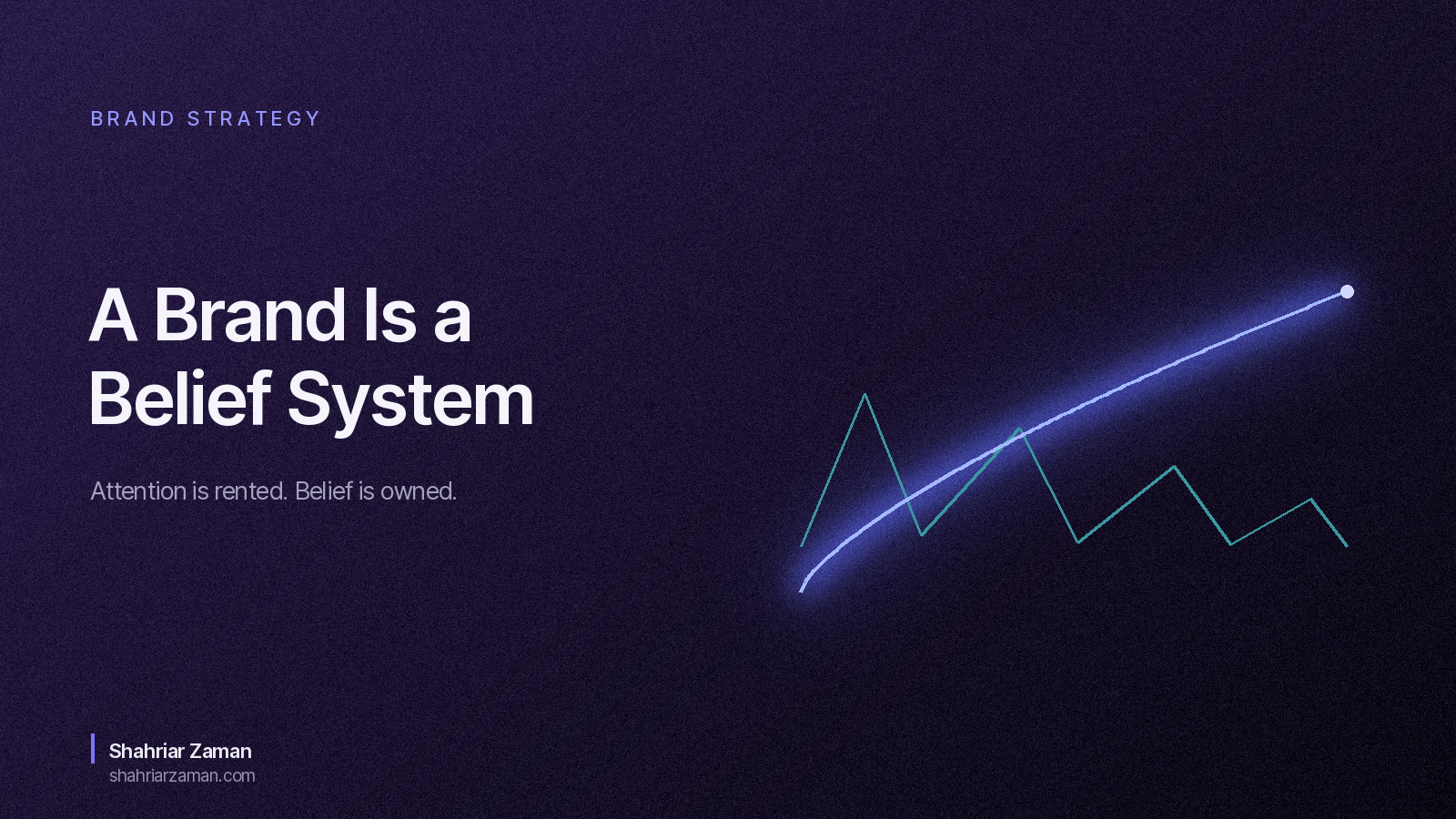
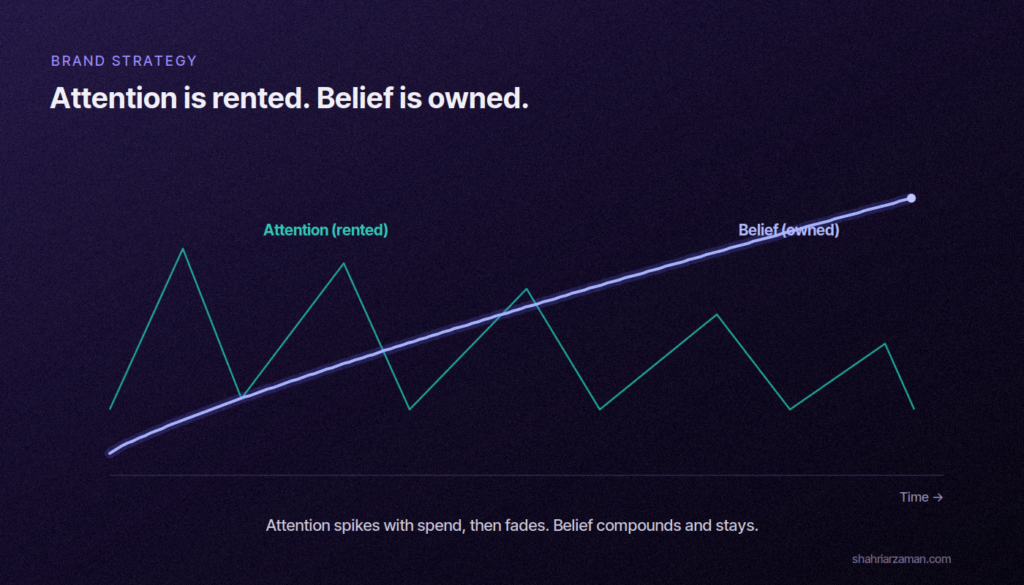
Attention is rented, belief is owned
This is the distinction I keep returning to. Attention is rented. You pay for it, it lasts as long as you keep paying, and it disappears the moment you stop. Belief is owned. It is expensive and slow to build, but once it is built it keeps working when the budget is cut, when a competitor outspends you, when you have a bad quarter and go quiet. A brand with belief can survive a silence. A brand with only attention cannot.
The businesses that confuse the two spend their whole lives renting, wondering why growth never compounds. The businesses that build belief are buying an asset, and the asset keeps paying long after the campaign that started it is forgotten.
What this asks of leadership
Here is why this is a leadership question and not a marketing one. If a brand is the sum of promises kept, then most of the promises are kept, or broken, by people who never sit in a marketing meeting. The delivery driver, the service agent, the person who decides whether to honour a warranty on a technicality. Brand is built or eroded at those points, which means brand is really a question of what the organisation believes about how it should treat people when it is inconvenient.
You cannot advertise your way out of a culture that breaks promises, and you do not need to advertise your way into one that keeps them. Marketing can articulate the belief. Only the organisation can make it true. The leader’s job is to make sure the two are the same thing.
The real question
So the question worth asking is not “what do we want people to think about us.” It is: what do we consistently do that would make them think it, whether we advertised it or not? If the honest answer is nothing yet, then there is no brand to build on, only a message to broadcast, and the market will believe its own experience over your message every time.
Attention is rented. Belief is owned. The strongest brands are not the loudest. They are the ones whose promises and behaviour have agreed with each other for long enough that people have simply come to believe them.
Key takeaways
- A brand is not what you broadcast. It is what people believe about you when you are not in the room.
- A campaign can introduce a belief, but belief only holds if the experience agrees with the message. When they disagree, people believe the experience.
- Belief is built from evidence, not assertion. Every touchpoint, especially the quiet ones, either confirms or contradicts the belief you want.
- The unit of brand-building is the kept promise, not the campaign. Trust is asymmetric, earned slowly and lost quickly, so one broken promise can undo many kept ones.
- Consistency builds belief and looks boring from the inside, which is why it is rare and why the brands that hold it pull ahead.
- Attention is rented and stops when you stop paying; belief is owned and keeps working through silence, competition, and a bad quarter.
- Brand is built or broken by people who never attend a marketing meeting, so it is a leadership and culture question, not a communications one.

Written by
Shahriar Zaman
Brand strategist and fractional CMO with 15 years of building category brands. Founder of Ads of Bangladesh and co-founder of Brand Practitioners Bangladesh. Based in Auckland.