The Distribution Ceiling: Why Growth Built on Availability Eventually Stalls
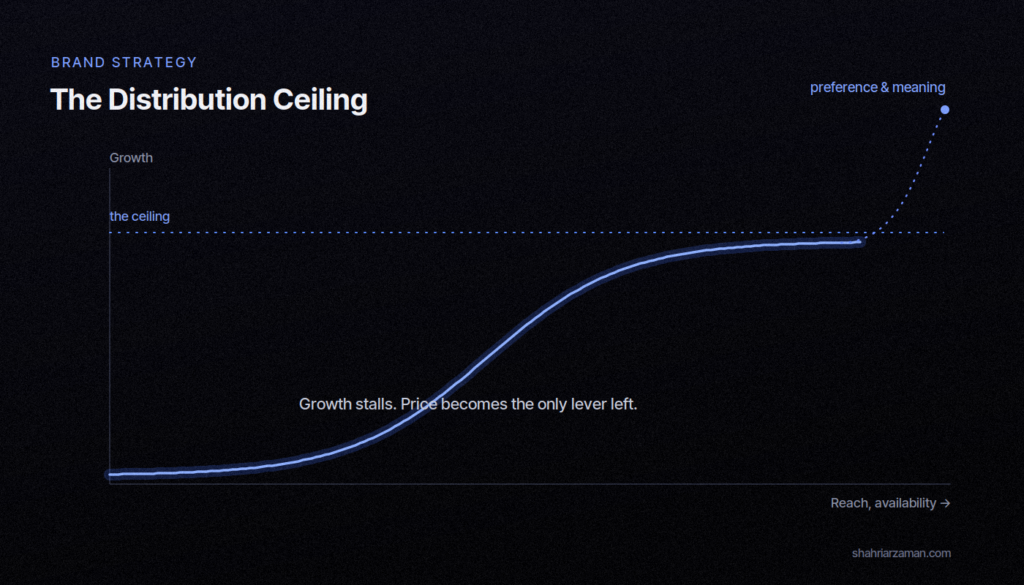
In most companies, a distribution win is cause for celebration. What no one names is the ceiling sitting just above it. Growth built on availability has a limit, and it stays invisible until the brand is already pressed against it. The Distribution Ceiling is my framework for why reach eventually stops producing growth, and how the strongest brands climb above it before price becomes the only lever left.
Last updated: September 26, 2026

In most companies, a distribution win is cause for celebration. A new region covered, a thousand more outlets stocking the product, a marketplace ranking climbed. The sales chart goes up and to the right, and everyone agrees the strategy is working. For a while, they are right.
What almost no one names in that meeting is the ceiling sitting just above the celebration. Growth built on availability has a limit, and the limit is not obvious until the brand is already pressed against it. I have watched businesses spend years and real money widening their reach, only to find that reach had quietly stopped producing growth. I call this the Distribution Ceiling, and understanding it is the difference between a brand that keeps compounding and one that ends up competing on price forever.
How a distribution advantage works, until it doesn’t
In a distribution-led market, and most emerging markets are distribution-led, a brand grows by being available. More dealers, deeper shelf presence, better trade terms, a stronger route to market. Availability is a genuine advantage. It is expensive to build, hard to copy quickly, and for a long stretch it reliably converts into volume.
The problem is that availability has a natural ceiling. The moment a serious competitor matches your reach, or modern trade and e-commerce flatten the shelf so that everyone is equally present, availability stops being a differentiator. It becomes table stakes. And a brand that built nothing but availability now has only one lever left to pull. Price. That is the ceiling, and margin is what dies against it.
The three altitudes
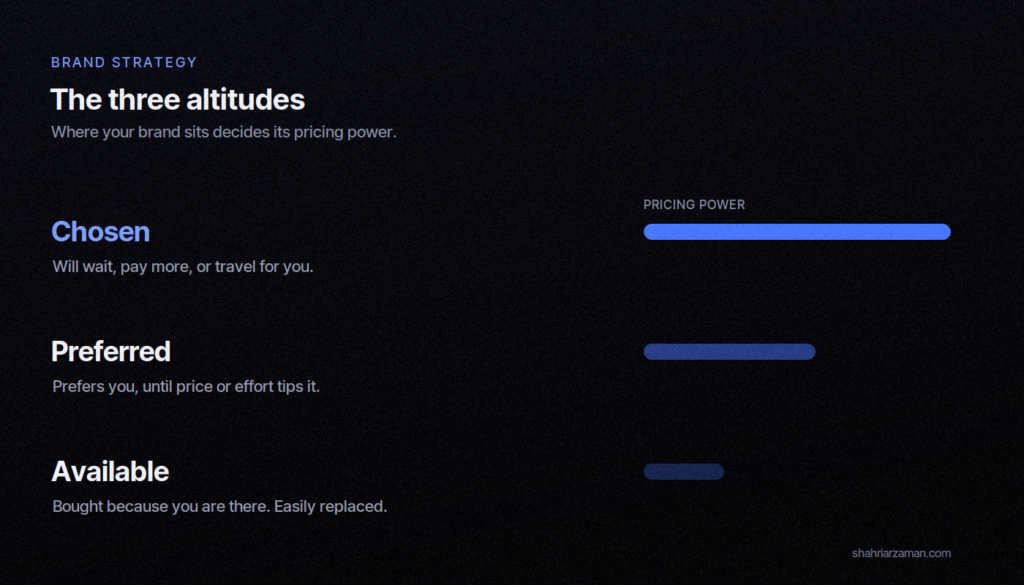
Underneath the ceiling, every brand sits at one of three altitudes, and the altitude decides how much pricing power it holds.
Available. The customer buys you because you are there. The instant something equivalent appears beside you, they switch. You are a habit, not a choice, and habits are cheap to break.
Preferred. The customer would rather have you, but will trade you away to save a little money or effort. It earns a small premium, and the premium is easily eroded.
Chosen. The customer will wait, travel, or pay more for you specifically. Now distribution follows demand instead of manufacturing it. This is where real pricing power lives, and it is the one altitude the ceiling cannot flatten.
Most brands pour everything into being more available, spreading wider, when the growth that lasts comes from climbing higher: from available, to preferred, to chosen.
Why the ceiling is invisible until you hit it
The reason the ceiling catches good companies off guard is that availability and preference feel identical on the way up. While you are the widest-distributed brand in the category, you cannot tell how much of your volume is genuine preference and how much is simply the absence of an alternative. The numbers look like loyalty. They are often just convenience.
You find out which one you had the day a competitor matches your shelf. If your volume holds, you had preference. If it collapses to whoever is cheapest that week, you had availability wearing a loyalty costume. By then it is late, and expensive, to build the preference you assumed you already owned.
The escape is altitude, not width
The brands that break through the ceiling did something earlier, while they still had room to move. They used the profitable years of a distribution advantage to buy the one thing distribution alone cannot deliver: a reason to be chosen. A point of view, a level of trust, a meaning that makes the customer want this brand rather than an equivalent one.
This is the counter-intuitive part. The best time to invest in preference is when you do not appear to need it, when availability is still doing the work. Building meaning is slow, and a brand that waits until reach stops working is trying to build a parachute after it has already hit the ceiling.
What this looks like in a trade-led market
In the categories where I have spent most of my career, building materials, FMCG, and the wider South Asian retail landscape, the dealer network is often the brand. Reach the trade and you have reached the market, and for years that is a complete strategy. It is also why so many strong local brands sit at the available altitude without realising it. Their volume is real, their distribution is enviable, and their preference is thinner than their market share suggests.
The opening, for a founder willing to see the ceiling early, is enormous. In a market where most competitors are still fighting to be more available, the brand that starts building genuine preference has very little company at the top. Altitude is uncrowded, precisely because everyone else is busy spreading wider.
The real question
The useful question for a leadership team is not “how do we expand distribution.” It is: if a competitor matched our reach tomorrow, would our customers still look for us by name? If the honest answer is yes, distribution is compounding a real advantage. If the honest answer is no, then reach is not building a brand. It is renting volume, and the rent goes up every year.
Distribution gets you onto the shelf. Only meaning gets you chosen from it. The ceiling is real, and the time to climb above it is always earlier than it feels.
Key takeaways
- Growth built on availability has a ceiling. Once a competitor matches your reach or the shelf flattens, availability stops differentiating and price becomes the only lever left.
- Every brand sits at one of three altitudes: available (a habit, easily switched), preferred (a small, erodible premium), or chosen (real pricing power the ceiling cannot flatten).
- The ceiling is invisible on the way up, because availability and preference produce the same numbers until a competitor matches your shelf and reveals which one you actually had.
- The escape is altitude, not width. Invest in preference while distribution is still working, not after growth has already stalled.
- In trade-led markets, many strong brands sit at the available altitude with thinner preference than their market share suggests, which is exactly where the opportunity is.
- The test: if a competitor matched your reach tomorrow, would customers still look for you by name?

Written by
Shahriar Zaman
Brand strategist and fractional CMO with 15 years of building category brands. Founder of Ads of Bangladesh and co-founder of Brand Practitioners Bangladesh. Based in Auckland.