The Rebrand Trap: When Changing How You Look Avoids Fixing What You Are
Few decisions feel as satisfying to a leadership team as a rebrand. New logo, fresh palette, confident launch, and suddenly the company looks like it is going somewhere. It photographs as progress, which is exactly what makes it dangerous. A rebrand is one of the few large gestures a business can make while changing nothing that actually matters. This is when a rebrand is honesty catching up, and when it is an expensive way to avoid the real problem.
Last updated: September 26, 2026
Few decisions feel as satisfying to a leadership team as a rebrand. A new logo, a fresh palette, a confident launch film, and suddenly the company looks like it is going somewhere. It photographs as progress. That is exactly what makes it dangerous, because a rebrand is one of the few large gestures a business can make while changing nothing that actually matters.
I have watched companies spend serious money and a year of attention redrawing their identity, when the problem was never the identity. The problem was the product, or the service, or a promise the business had quietly stopped keeping. A rebrand cannot fix any of those. What it can do, dangerously well, is make everyone feel as though something has been fixed.
The rebrand as displacement activity
Changing how a company looks is enormously easier than changing what a company does. One is a design project with a clear end date and a launch to celebrate. The other is slow, political, and never really finished. When a business is uneasy and not sure why, the rebrand offers a tempting substitute: visible motion in place of difficult change. It is the corporate version of reorganising your desk when the essay is due.
The tell is usually in the brief. When a rebrand starts from “we need to look more modern” rather than “we have become something different and our identity no longer tells the truth,” it is almost always solving for the symptom. Looking dated is rarely the actual disease. It is what a deeper problem looks like from the outside.
What a rebrand can and cannot fix
It is worth being precise about what a new identity can actually do, because it can do something real. A rebrand can signal a change that has already happened. When a company has genuinely transformed, a new look helps the market catch up to a truth that is already true. In that case the identity is not the change. It is the announcement of it.
What a rebrand cannot do is create the change it depicts. A fresh logo on an unchanged business is a promise the business still cannot keep, made more loudly. If anything it accelerates the disappointment, because it raises expectations the experience will immediately contradict. Dress a broken promise in a beautiful new identity and you have not hidden it. You have spotlit it.
The questions a rebrand quietly dodges
The reason a rebrand is such an effective avoidance mechanism is that it lets an organisation feel decisive while never answering the harder questions underneath. What do we actually stand for now, and is it different from what we stood for before? What is the real reason customers are drifting, and is it anything a logo touches? If we changed nothing about how we look but fixed the thing customers actually complain about, would we still feel the need to rebrand?
Those questions are uncomfortable because they point inward, at strategy and behaviour, not outward at design. A rebrand lets a leadership team spend a year looking busy without ever having to sit with them. That is its appeal, and its trap.
When a rebrand is genuinely right
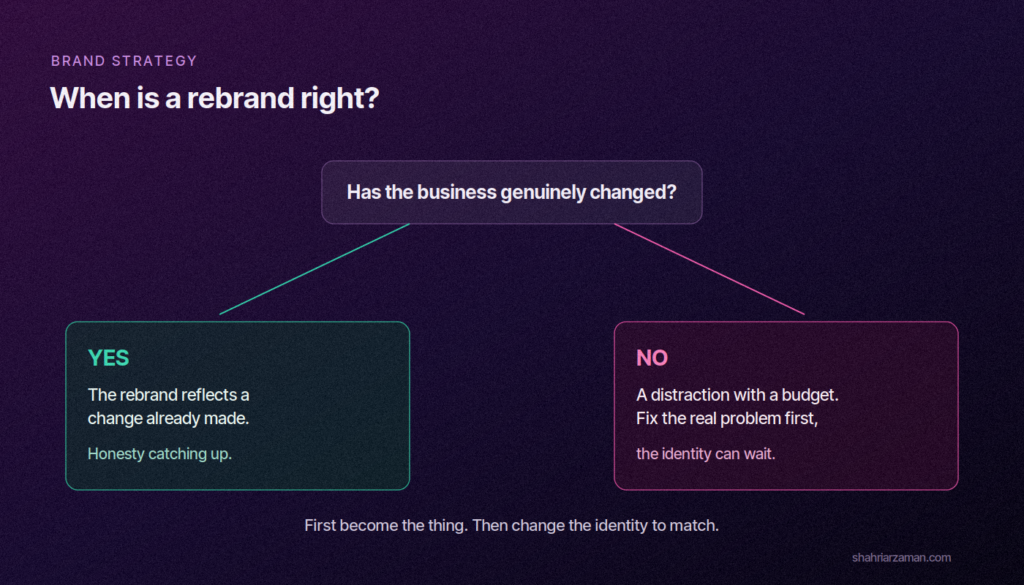
None of this means rebrands are vanity. There are real reasons to change an identity, and they share one feature: the change in the business comes first, and the identity follows. A genuine strategic shift, a merger that has to become one company, a name that now actively misleads, an identity built for a business the company no longer is. In each case the rebrand is closing a gap between what the business has become and what it still looks like. That is not avoidance. That is honesty catching up.
The distinction is simple to state and easy to dodge. A good rebrand reflects a change that has already been made. A bad one is hoping to be the change. If you cannot point to what is now true about the business that was not true before, you do not have a rebrand. You have a distraction with a budget.
Why the appetite comes from inside
It helps to notice where the pressure for a rebrand usually comes from. It rarely comes from customers, who almost never wake up wishing their favourite brand looked different. It comes from inside: a new leader wanting to leave a mark, a team that has grown bored of its own identity long before the market has, an agency with an obvious incentive to recommend the biggest possible project. Familiarity feels like fatigue from the inside, but from the outside that same consistency is what belief is made of.
This is the quiet cost that rarely makes it into the business case. Every rebrand spends down some of the recognition and trust the old identity had accumulated. Sometimes that trade is worth it. Often the company is burning an asset it spent years building, to solve a boredom only it can feel.
The test before you rebrand
So before redrawing the identity, it is worth applying a single test. Write down, in plain language, what has genuinely changed about the business that the current identity fails to express. If the list is real and specific, a rebrand may be exactly the right way to tell that story. If the list is vague, if it reduces to looking tired or wanting a refresh, then the money and the year would be better spent on whatever is actually broken, and the identity can wait until there is something new to say.
The real question
The question is never “do we need a new look.” It is: have we become something the world needs to be told about, or are we hoping a new look will make us into something we have not yet done the work to be? The first is a reason to rebrand. The second is a reason to stop, and go fix the thing the rebrand was trying not to look at.
Changing how you look is not the same as changing what you are. The strongest brands understand the order. First you become the thing. Then, and only then, you change the identity to match.
Key takeaways
- A rebrand photographs as progress, which is exactly why it is often the most expensive way to avoid changing anything that matters.
- Changing how a company looks is far easier than changing what it does, so a rebrand can become displacement activity: visible motion in place of difficult change.
- A rebrand can signal a change that has already happened, but it cannot create the change it depicts. A new logo on an unchanged business only spotlights the broken promise.
- The appetite for rebrands usually comes from inside, from bored teams, new leaders and incentivised agencies, rarely from customers, who read consistency as trust, not fatigue.
- Every rebrand spends down accumulated recognition and trust. Sometimes it is worth it, often it burns an asset built over years to solve a boredom only the company can feel.
- The test: name what has genuinely changed about the business that the current identity fails to express. If the list is vague, fix the real problem and let the identity wait.
- A good rebrand reflects a change already made. A bad one hopes to be the change. First become the thing, then change the identity to match.

Written by
Shahriar Zaman
Brand strategist and fractional CMO with 15 years of building category brands. Founder of Ads of Bangladesh and co-founder of Brand Practitioners Bangladesh. Based in Auckland.